Agile and waterfall are the two dominant frameworks for managing projects, and the debate between them has been running for decades. In practice, most teams don't follow either one purely — they adapt elements of each depending on the project. But understanding the core differences helps you make that adaptation deliberately rather than by accident.
This article explains what each approach actually involves, where each one works well, and how to decide which fits your situation.
What Is Waterfall?
Waterfall is a sequential approach to project management. Work flows through a fixed set of phases — typically: requirements, design, development, testing, deployment — and each phase must be completed before the next begins.
The name comes from the image of water flowing down over a series of steps: once you pass a stage, you don't go back up. Requirements are defined in full before design starts. Design is complete before development begins. There's no coding during the requirements phase and no new requirements accepted during development.
Waterfall projects are characterized by:
- A detailed project plan created at the beginning
- Fixed scope, defined upfront
- Progress measured by completing phases
- A single delivery at the end of the project
The main tool for planning and tracking waterfall projects is the Gantt chart — a timeline showing every phase and task laid out across the project duration.
What Is Agile?
Agile is an iterative approach. Work is broken into short cycles called sprints (typically one to four weeks), and each sprint produces a working increment of the product. Requirements evolve through collaboration with stakeholders, and the team adjusts direction based on feedback as they go.
Rather than one big delivery at the end, agile teams ship small, usable pieces of the product throughout the project. Each sprint ends with a review where stakeholders see what was built and can influence what comes next.
Agile projects are characterized by:
- Flexible, evolving scope
- Short planning cycles
- Progress measured by working software
- Continuous delivery of value throughout the project
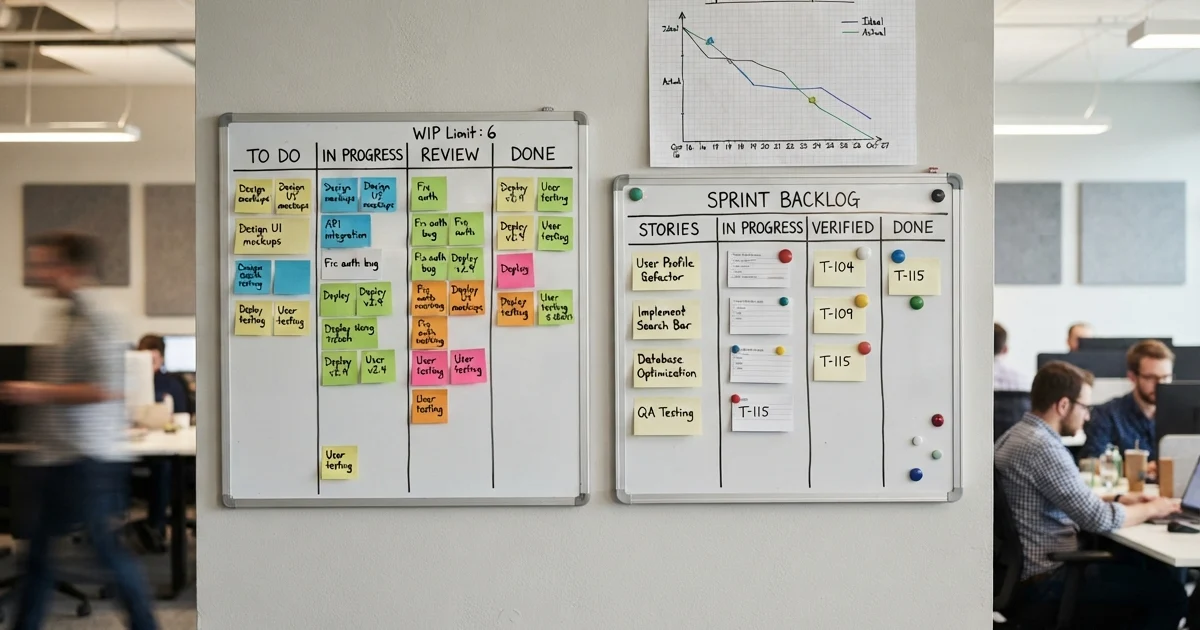
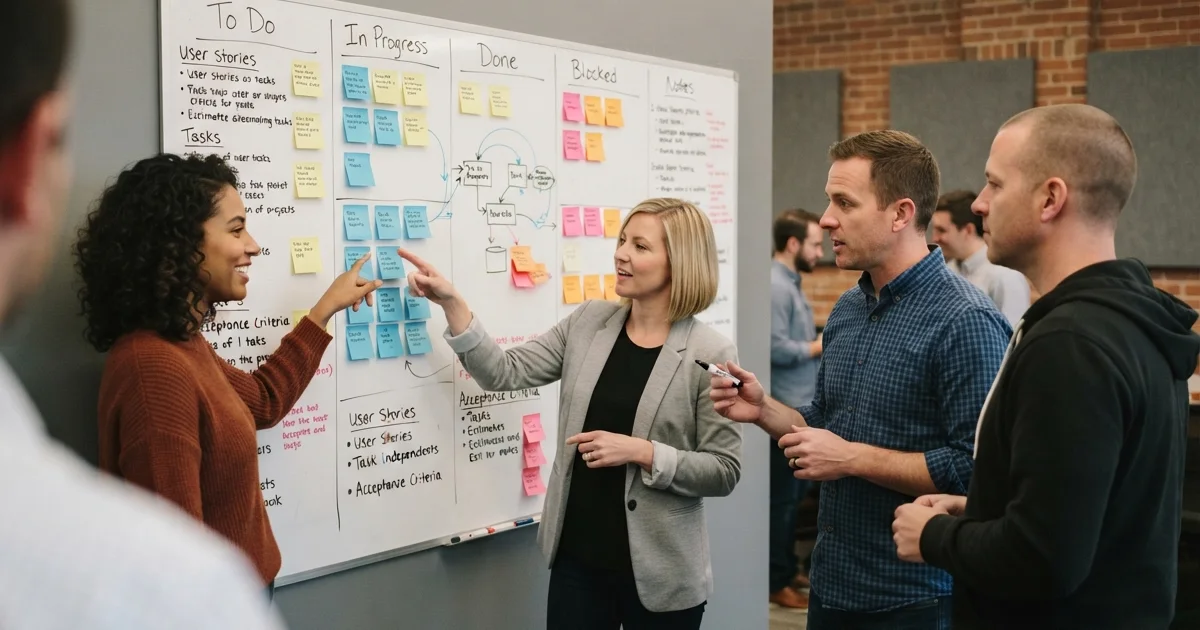
The primary tools for agile teams are the sprint planning board and the kanban board — visual systems that show what's being worked on, what's in progress, and what's done, updated continuously.
The Key Differences
Planning
Waterfall: All planning happens upfront. The project scope, timeline, and budget are defined before work begins. This makes waterfall easier to estimate — you know what you're building before you start.
Agile: Planning is continuous. The team plans one sprint at a time, with only a rough backlog of future work. This makes the total cost and timeline harder to predict, but allows the plan to respond to what you learn as you build.
Handling Change
Waterfall: Change is expensive. Adding a new requirement mid-project often requires revising the design, which cascades into development rework. The process is explicitly designed to lock in requirements early and defend them.
Agile: Change is expected. The iterative structure means new information — from users, from the market, from testing — can be incorporated into the next sprint. The cost of change doesn't compound the way it does in waterfall.
Delivery
Waterfall: One delivery at the end. Stakeholders don't see working software until the project is complete, which means problems discovered late are expensive to fix.
Agile: Continuous delivery. Stakeholders see working software at the end of every sprint, which means feedback is constant and problems surface early.
Risk
Waterfall: Risk is front-loaded into the requirements phase. If the requirements are wrong, the entire project is built on a flawed foundation, and the error isn't discovered until testing or delivery. This is the waterfall failure mode: a project that delivers exactly what was specified and nothing like what was needed.
Agile: Risk is distributed across sprints. An incorrect assumption is discovered within one sprint cycle, not at the end of a year. The failure mode is different: without discipline, agile teams can lose direction and keep iterating without clear progress.
Team Structure
Waterfall: Teams are often organized by function — design team, development team, QA team — and hand work off between them sequentially. The project manager coordinates across teams.
Agile: Teams are typically cross-functional — a single squad includes design, development, and QA working together throughout. The team owns the product from concept to delivery.
Documentation
Waterfall: Documentation is comprehensive and front-loaded. Requirements documents, design specifications, and test plans are artifacts of the process.
Agile: Documentation is lightweight and just-in-time. The working software is the primary artifact, and documentation is written to support understanding, not to drive it.
When Waterfall Works Better
Waterfall is genuinely the right choice in some situations:
Fixed scope, fixed contract. If you're building to a specification with no flexibility — a government contract, a fixed-price engagement, a regulatory requirement — waterfall's sequential structure matches the constraints. Agile's scope flexibility is a liability when the contract is fixed.
Well-understood problem. If you've built this type of system before, the requirements are stable, and the technology is known, waterfall's upfront planning doesn't waste time on premature iteration. The cost of planning is justified by the predictability it creates.
Hardware and physical deliverables. When you're building something that has physical dependencies — manufacturing, construction, embedded systems with hardware constraints — you often can't iterate the way software teams can. Changing a circuit board design mid-production is not equivalent to changing a software feature.
Regulated industries. Healthcare, aerospace, financial systems, and other regulated environments often require detailed upfront documentation and sequential sign-offs as part of compliance. Agile can work in these contexts but requires adaptation.
When Agile Works Better
Unclear or evolving requirements. If you don't know exactly what you're building — a new product in an uncertain market, an internal tool where user needs are still being discovered — agile's iterative approach lets you learn as you go. Locking in requirements for something you don't fully understand yet is how waterfall projects produce the wrong thing on time and on budget.
Software products with real users. User feedback changes what matters. A feature that seemed essential in the requirements phase may turn out to be less important than something discovered in sprint three. Agile creates the structure to respond to that.
Fast-moving competitive environments. When the market is changing and speed to value matters more than perfect upfront planning, agile's continuous delivery gives teams a faster feedback loop.
Long projects with high uncertainty. The longer a project runs, the more likely the world will change around it. A two-year waterfall project in a fast-moving industry is a gamble that nothing significant will change in two years. Agile distributes that risk.
The Reality: Most Teams Use Both
Pure agile and pure waterfall are ideals. Most professional teams use a hybrid:
- Agile teams with waterfall gates: Sprints for development, but a fixed deadline and defined scope for a release or milestone.
- Waterfall projects with agile practices: Sequential phases, but with user testing and feedback loops built into each phase.
- Different methods for different project types: The same organization might use waterfall for compliance-driven infrastructure projects and agile for product development.
The useful question isn't "are we agile or waterfall?" — it's "which parts of our project have known requirements and which don't?" Apply sequential planning where requirements are stable and iterative planning where they aren't.
Tools for Each Approach
Waterfall: The primary planning tool is the Gantt chart — a timeline showing each phase, its duration, and its dependencies.
Agile: The primary tools are the kanban board (continuous flow) and sprint planning board.
If you're still deciding which approach suits your team, Kanban vs Gantt explores the visualization tools behind each method in more detail.
Summary
| Dimension | Waterfall | Agile |
|---|---|---|
| Planning | Upfront and complete | Continuous and incremental |
| Scope | Fixed | Flexible |
| Delivery | Single, at the end | Continuous throughout |
| Change | Expensive | Expected and managed |
| Risk | Back-loaded | Distributed across sprints |
| Best for | Known requirements, fixed contracts | Evolving requirements, uncertain markets |
Neither method is inherently superior. The right approach depends on how well you understand what you're building, how stable the requirements are, and how much the external environment is likely to change during the project.