A restaurant hiring process combines availability screening, a structured interview, a lawful skills assessment, credential checks, onboarding, and scheduling. The assessment must never become free labor: when a candidate performs productive work or the business controls the activity as work, treat the time as paid and check the rules that apply where you operate.
This guide walks through how to build a restaurant hiring process from job post to first shift, then shows the three shapes it takes in a fast-food counter, a full-service dining room, and a coffee shop. You can adapt the restaurant hiring process template and edit the roles, gates, and schedule directly in the browser.
What a restaurant hiring process should achieve
A workable hiring flow answers three questions a generic funnel ignores. First, can this person actually hold a station during a rush — not just in a quiet interview room? Second, do they have the certifications the health code requires before day one? Third, do their available hours match the shifts you actually need covered?
That last point is where most hiring goes wrong. You can interview a great server, run a trial, and sign the offer, only to discover they cannot work Friday nights — the shift you posted for. Screening availability in the first conversation costs nothing and saves the entire process.
A useful process should produce five outcomes:
- every candidate is screened for shift availability before you spend time interviewing;
- any live skills check is paid, supervised, time-limited, and assessed against the same rubric;
- role-specific credentials are checked at the legally appropriate stage;
- a failed trial has a retrain path instead of a hard no;
- the schedule is built around peak hours and shown to the new hire.
How to build a restaurant hiring process
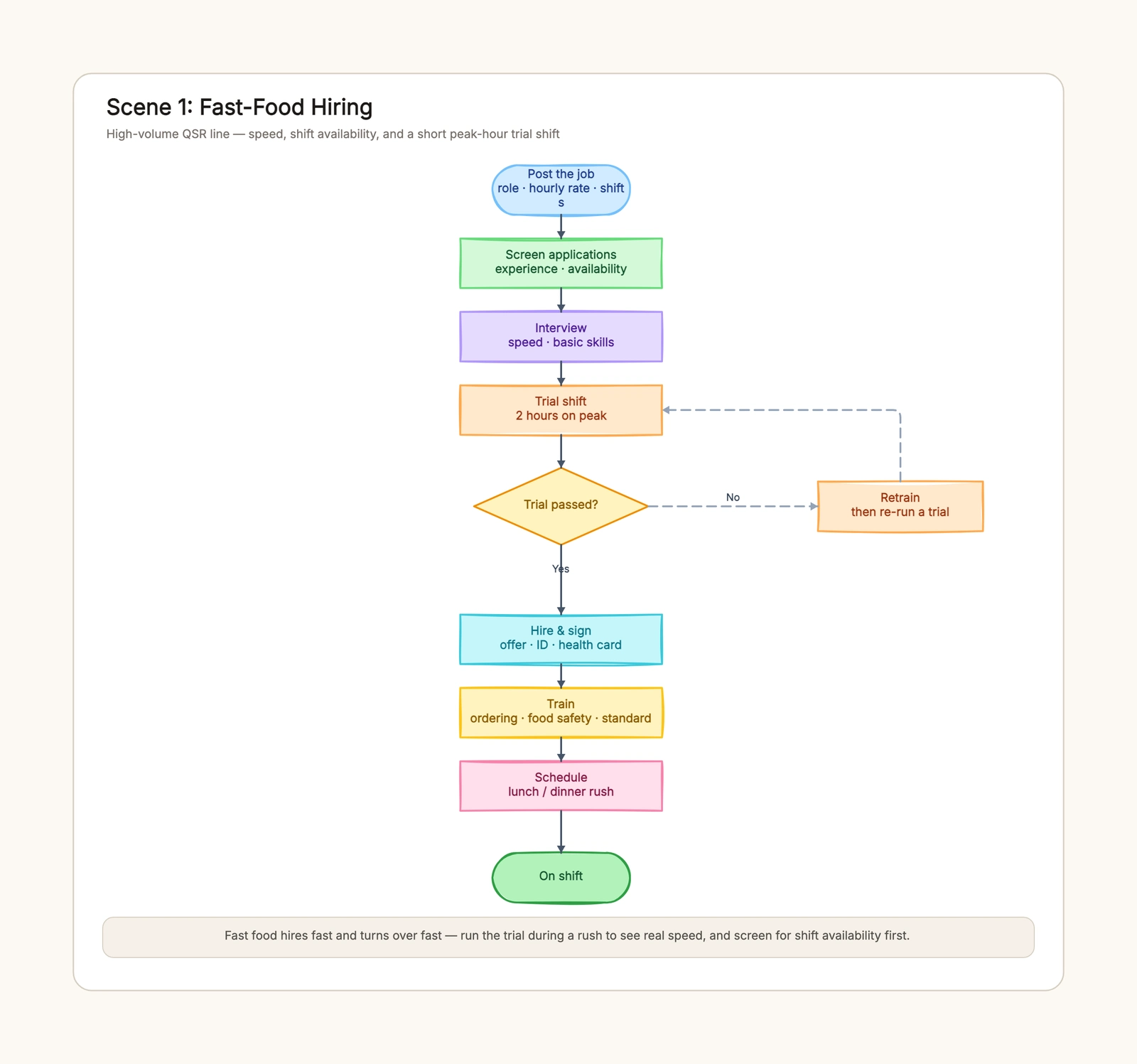
The backbone is the same for every venue: post, screen, interview, assess skills lawfully, hire, train, schedule. What changes is the assessment design, which documents you check, and what the schedule looks like. Start from the venue type and branch from there.
1. Post the job with the real constraints
Write the role, the pay, the shifts, and the certification you will require. "Server needed" gets resumes; "server needed, Friday and Saturday nights, food-handler card required" gets candidates who already know they fit. The more honest the posting, the less time you spend on interviews that go nowhere.
2. Screen for availability before the interview
Ask for available hours in the first reply, not the third interview. A candidate who can only work weekday mornings is not a candidate for your weekend dinner rush, no matter how well they interviewed. Availability is the cheapest filter in the whole flow, and the one most managers skip.
3. Interview for service sense and basic skill
The interview checks the résumé claims through consistent questions about pace, judgment, and customer situations. For back-of-house, ask about safe technique and prior examples. Keep it focused, then use the same structured skills exercise and scoring rubric for each candidate.
4. Use a lawful, structured skills assessment
Choose an assessment that matches the role without exposing a candidate or guests to avoidable risk. A cook might explain station setup and complete a short paid task under supervision; a server might role-play a table with staff rather than carry a live section. Use the same checklist for every candidate. If the exercise produces work for the restaurant, schedule and pay it as work and confirm local wage, insurance, food-safety, and child-labor requirements.
5. Check certifications before signing
Credential rules differ by location and role. Build a role-by-role checklist from the relevant regulator or licensing authority, record when each item was verified, and avoid treating a certificate as universally mandatory when local law does not require it. Tell the candidate which items must exist before work begins and which the employer can arrange during onboarding.
6. Train, then schedule around peak hours
Training covers the menu, the service flow, and food safety — and for a café, the recipes and equipment. Only after that does the hire enter the roster, which is built around the rushes, not around empty hours. Show the new hire the schedule so they know what they are agreeing to.
Design the skills check without creating free labor
An assessment can add useful evidence, but it does not need to imitate a full shift. Start with a job sample that is short, supervised, safe, and scored against a written rubric. Tell the candidate in advance what they will do, how long it will take, what rate applies if it is paid work, and who is responsible for safety.
Do not place an unpaid candidate into normal operations during a rush. For pressure testing, use a simulation, timed ticket exercise, or role-play with employees. If you decide a live service is necessary and lawful, put the person on payroll first, provide training and protective equipment, limit the scope, and keep a qualified supervisor present.
Allow a consistent reassessment path when appropriate. Record the observed behavior rather than a vague impression, provide the same preparation to every candidate, and avoid repeated working interviews that merely extend a tryout without a hiring decision.
Fast-food example
Fast food often hires quickly, so keep the flow and skills exercise focused. The posting lists the role, hourly rate, and shifts; screening checks availability against the actual vacancy before either side invests more time.
For a counter role, a short paid simulation can test prioritization and communication: present several sample tickets, introduce a stock-out, and ask the candidate to explain the order of work. This produces comparable evidence without using an unpaid applicant to cover a real lunch rush.
After a pass, complete the offer and the role-specific checks required locally, then train the employee on ordering, food safety, and station standards before independent work. Add the person to the agreed shifts only after onboarding requirements are complete.
Full-service example
A full-service house hires fewer people and spends longer on each, because a bad server or cook costs a whole service. The posting separates front and back of house; screening adds skills and a start date to the availability check.
For full service, use role-specific scenarios rather than an unpaid full shift. A server can role-play greeting, allergy escalation, and an upset guest; a cook can demonstrate setup and safe technique in a controlled paid assessment. Verify only the credentials required for that role and location.
Training is menu-heavy for the floor and rules-heavy for the kitchen, and the schedule splits morning, evening, and weekend shifts. The process is longer because the stakes per hire are higher.
Coffee shop example
A café runs a small team where one person may cover the register, the machine, and closing tasks in one shift. The assessment can therefore test task switching, drink steps, and closing judgment in a controlled exercise without assigning an applicant to live rush operations.
The interview checks prior drink and service experience; a simulation shows how the candidate sequences orders, communicates a stock-out, and maintains a clean station. Employment training then covers recipes, standards, and equipment care.
The schedule clusters around the morning rush and weekends. For more on the roster that follows the hire, the shift schedule template covers peak-hour coverage directly.
Scheduling is where hiring actually finishes
A restaurant hiring process is not over when the offer is signed. It is over when the new hire is on the schedule and knows their shifts. The roster exists to cover rush periods, and every hire has to fit it.
Screen availability early, build the schedule around peak hours, and show it to the candidate before they sign. That closes the loop: the person you hired is the person who can work the shifts you posted for. For the mirror image — what happens when someone leaves — the employee offboarding template covers the handoff and asset checks.
Common restaurant hiring mistakes
Using an unstructured or unpaid working interview
Dropping an applicant into ordinary operations creates inconsistent evidence and can create wage, safety, and insurance problems. Use a written rubric and a controlled simulation; when the candidate performs productive work, handle the time as paid work under the rules that apply locally.
Testing pressure by exposing guests or candidates to risk
A live rush is not the only way to test prioritization. Timed scenarios, mock tickets, and role-play make the conditions repeatable and keep an untrained applicant out of a safety-critical station.
Hiring before checking certifications
Do not copy a credential checklist from another city or role. Confirm the current requirements with the relevant local authority, then state clearly which documents are required before work begins.
Ignoring shift availability
A strong candidate may still be a mismatch for a weekend-night vacancy. Discuss essential availability in the first conversation, apply the same job-related requirement consistently, and avoid collecting schedule information unrelated to the role.
No retrain path on a failed trial
One unsuccessful assessment need not automatically mean rejection. Where appropriate, offer one reassessment under the same conditions, document the preparation provided, and avoid repeated working interviews that postpone a decision.
Keep the process useful over time
Review the flow after each hire and note where it failed—a vacancy whose hours were unclear, a skills exercise without consistent evidence, or a local requirement checked too late. Each correction reduces avoidable rework on the next opening.
A short version—role, availability, lawful skills assessment, credentials, schedule—belongs in your notes so the next opening starts from a working process. Start with the restaurant hiring process template, replace the roles and gates, and add pay and supervision whenever an assessment includes productive work. For the roster that follows, see the shift schedule template, and for the physical space, the restaurant floor plan template.